A tender family drama about identity under Singapore's capitalist pressures.
The film follows a humble Hokkien mee hawker, Boon Kiat (Andi Lim), and his idle yet ambitious son, Junyang (Koh Jia Ler). Junyang tries his hand at various avenues to get rich, but there is no real goal or direction guiding him. He only knows that he wants a lucrative job, and he wants it quickly and easily.
But there is another reason behind his desire to get rich: Lydia (Regene Lim). The daughter of a Christian teacher, Lydia is well-read, mild-mannered, and plays the piano. Junyang’s attempts to climb the financial ladder are, in part, driven by his desire to impress Lydia’s mother and earn her acceptance.
Elsewhere, amidst the daily struggle to keep their modest lives together, Boon Kiat has found love as well. Bee Hwa (Yeo Yann Yann) is a scrappy Malaysian-born immigrant who earns her living convincing coffeeshop uncles to buy beers from her. She is cynical and pragmatic, but softens when she notices Boon Kiat’s shy attempts at courting her.
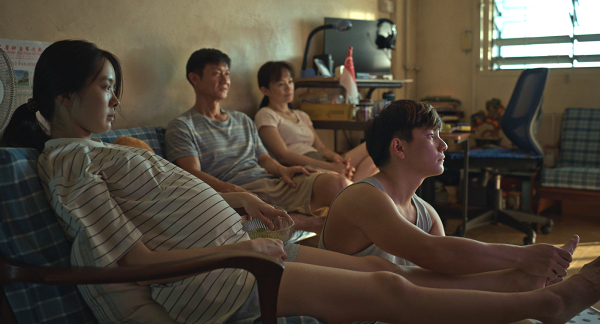
Circumstances force these characters to take root, and emotions begin to bloom. Eventually, both Lydia and Bee Hwa marry into the family, squeezing into the same small government apartment that Boon Kiat owns. Together, the quartet finds themselves confronting love, growth, and identity, while being forced to redefine what “family” actually means.
The films opens with a sequence of Boon Kiat preparing a plate of Hokkien mee. He hand-peels his prawns, masterfully fries his noodles amidst oil and smoke, before drenching a ladle of broth over them and leaving them to simmer. The act is supposed to be repetitive and tiresome, especially for a man who has spent decades performing it, but we don’t sense that. It is laborious and it is hard work, but it is done so with love. This singular scene is what sets the tone for the rest of the film.
The Hokkien mee has allowed Boon Kiat to not only provide for himself and his son, but also to remain connected to his community. He offers free plates to old regulars who struggle financially and refuses to increase the price of his noodles, even in the face of inflation. It is through the noodles that he manages to make Bee Hwa (whose masterful acting chops are on full display) feel cared for, his kindness permeating her gritty exterior.
Juxtapose this with the way Junyang’s polluted pursuit of a career is portrayed, and herein lies one of the film’s main themes: the socialisation that occurs within the economic pressure cooker of Singapore. Junyang’s ear is clogged with pressure from Lydia’s mother to provide for her daughter, alongside stories of his friends making easy money from selling property. And when no one is in his ear, TikTok is. He spends whatever free time he has scrolling through social media, consuming content about the easy money to be made through e-commerce.
So, after completing national service, he tries everything: being a grab delivery rider, property agent, and e-commerce hustler—anything to avoid becoming a hawker like his father. But there is no tenderness in the scenes of him hustling up office buildings, no warmth in walking clients through a fugazi showroom.
It is only by the end of the film, after being bitten by every attempt at getting rich quick, losing his father, and becoming a father himself, that he finally returns to the Hokkien mee stall that helped raise him. The shots slow down, and it suddenly feels as if Boon Kiat is back behind the stove, making each plate of Hokkien mee with love and attention.
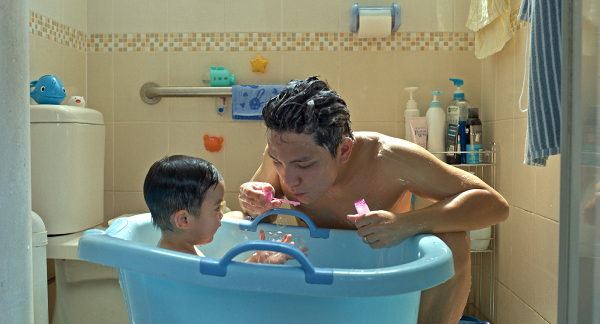
Perhaps, like his father, he has learned that there is poetry in an ordinary life. The same way joy can be found in discovering an apple your lover left in your bag, or in the bubble wand you use with your son in the bathtub. Beauty exists in caring and being cared for.
But within the economic powerhouse that thrives under capitalism, that hardly seems enough. Beauty exists in the gleaming watch, the new pair of limited-edition sneakers, the shiny new job title. Singapore is widely regarded as the bridge between the east and west, not just in trade and finance, but in culture and society. As a result, many Singaporeans find themselves stuck somewhere in between, unsure of where they belong. To some, the grass awaiting on the other side of the bridge may appear greener than the eastern grass from which they stand.
For Junyang, he has to adopt Steve as an English name to appear dependable and competent as a real estate agent. English is closely tied to professional mobility, while Chinese is more commonly associated with life at home. He’s reminded to announce that the home appliances he promotes are imported from Europe, as are the health supplements he sells on TikTok. At every step of his professional career, he is warned to supress his cultural roots in favour of the west. The contradiction in cultural identity is something the film tackles subtly, and it may easily go unnoticed.
But to write this off simply as “the duality of being Singaporean” would feel reductive, because the truth is many Singaporeans are well aware of these contradictions to the local identity. We see them, then we do our best to hide them.

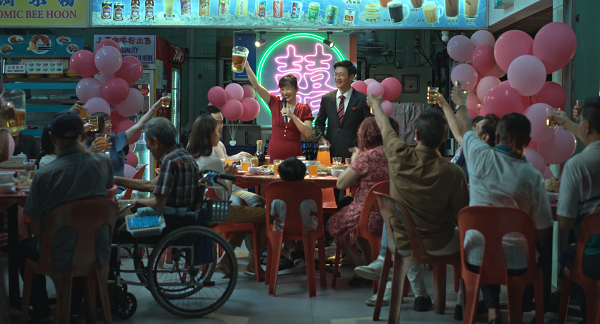
Junyang and Lydia had a flourishing five-star hotel banquet wedding serving wine and whiskey, while Boon Kiat and Bee Hwa had a modest coffeeshop ceremony with only tiger beer to go around. But the ironic twist is that all four newlyweds end up having to share the same small, run-down government HDB flat afterward anyway.
Chen uses the Singaporean family melodrama format to raise a number of important issues and themes for the audience to think over, particularly on identity within the Singaporean context, and how we shape ourselves under the weight of economic pressure.
The most notable shortcoming of the film comes from the development of Lydia’s character. Her story is given time and space to breathe only at the start. After moving into the family’s public housing flat, she more or less fades into the background, and the storylines that do develop around her feel flat and insufficiently justified. It is never explained why she decides to keep the child, nor why she appears largely unaffected by the sudden decline in her standard of living. In fact, this lack of explanation extends to her mother as well, who initially seems to resent the idea of Lydia marrying Junyang, only to promptly disappear without much friction after the wedding.
Through most of the film, Lydia barely registers as someone real. It isn’t until the very end that it feels as though Chen suddenly recalls her existence and attempts to tie up the loose ends of her story. Her resolution comes in the form of a return to academia, but we were never given much indication that she was struggling with this until just a few minutes before that resolution.
We Are All Strangers is a film that adopts a slow-cinema approach, placing precedence on its characters over its plot which we’re fully in favour of. But it is still worth noting that the film falls into some fairly familiar clichés. The lucrative-health-supplement-turned-illegal-business trope, in particular, is one we have seen repeatedly in Singaporean media. While it has been reworked to fit the contemporary world of social-media e-commerce, it’s difficult to take those moments entirely seriously when the film suddenly starts to feel suspiciously Jack Neo-adjacent.
Look out for the ways Junyang is subtly socialised into adopting a West-is-superior mentality, particularly in how he navigates identity within the pressure cooker of Singapore’s economic landscape.
We Are All Strangers is now out in theatres.